
Table of Content's
1. What is Accounting Profit?
- Accounting profit is defined as the net income generated by a company after deducting all financial, operating, and tax expenses from its total revenues.
- This calculation is conducted in strict compliance with globally recognized accounting principles, such as Generally Accepted Accounting Principles (GAAP) and International Financial Reporting Standards (IFRS).
Understanding your company's accounting profit is crucial for measuring its overall financial performance over a specific period.
It serves as one of the most vital financial metrics relied upon by business owners, investors, and financial analysts to evaluate corporate profitability and operational efficiency.
- How to Calculate Accounting Profit?
Accounting profit is determined by subtracting all explicit, actual costs from the total top-line revenue using the following financial formula:
Accounting Profit = Total Revenue - Total Explicit Expenses
- Key Concepts of Accounting Profit:
Accounting profit reflects the actual net income of a business after deducting all operating, financial, and financing costs.
It factors in all tax liabilities, operational overheads, production costs, and administrative expenses.
It serves as a primary tool to analyze, benchmark, and measure the overall financial performance of corporate entities.
Accounting profit is conceptually distinct from both economic profit and taxable profit.
It represents the baseline and fundamental pillar required to prepare and file accurate corporate tax returns.
2. What is Taxable Profit (Tax Profit)?
Taxable profit (or tax profit) refers to the net income framework determined in accordance with the specific tax laws and statutory regulations enforced by the state (such as ZATCA regulations in Saudi Arabia) to calculate the exact tax liability of a business.
Unlike accounting profit, which follows accounting standards, taxable profit is adjusted to align with tax legislation by adding back non-deductible expenses and subtracting non-taxable revenues.
How to Calculate Taxable Profit Taxable profit is calculated by adjusting the accounting profit using the following:
Taxable Profit = Accounting Profit + Non-Deductible Expenses - Non-Taxable Income
3. The Importance of Accounting Profit:
Accounting profit is widely recognized as one of the most critical financial metrics for evaluating a business's health and sustainability. It serves a vital role in helping businesses achieve the following:
It measures the effectiveness of a company's internal management and production capabilities in controlling costs relative to revenues.
It determines the enterprise's core ability to generate sustainable returns from its commercial activities.
It provides business leaders and executives with a realistic overview to guide strategic expansions, pricing models, and budget allocations.
It acts as the structural baseline for compiling organized and compliant income statements, balance sheets, and cash flow reports.
It serves as the initial starting point from which adjustments are made to calculate the final taxable profit.
It allows stakeholders, financial analysts, and investors to evaluate corporate growth and compare performance against industry competitors.
Chief Financial Officers (CFOs) and corporate managers rely heavily on accounting profit to accurately gauge and evaluate the company's overall financial health.
4. The Benefits of Accounting Profit for Businesses:
Tracking accounting profit provides investors, shareholders, and business owners with distinct strategic advantages, including:
It streamlines the process of financial analysis, allowing stakeholders to easily interpret profitability and break down complex corporate performance into clear, actionable metrics.
It plays an indispensable role in financial reporting, making it straightforward for internal teams to compile compliant quarterly and annual balance sheets and income statements.
It enables investors to conduct accurate corporate comparisons, evaluating the financial standing and market position of different companies within the same industry.
It serves as a reliable data source that guides leadership in making sound financial decisions, from funding future expansions to optimizing operational budgets.
5. What is the Difference Between Accounting Profit and Taxable Profit?
While accounting profit and taxable profit are both foundational concepts in corporate finance, they serve entirely different purposes and are governed by distinct frameworks. Understanding these core differences is essential for accurate financial management and regulatory compliance.
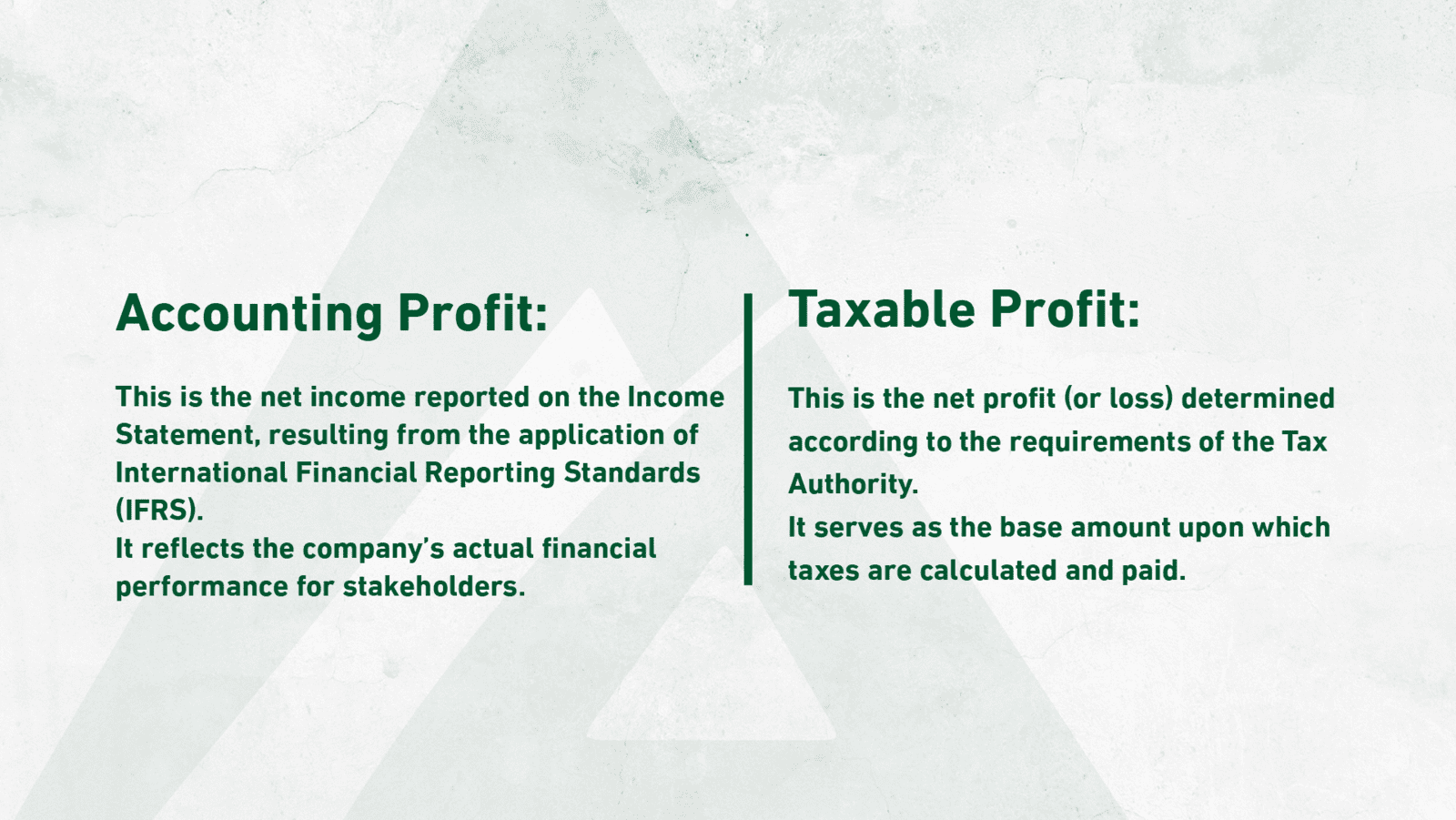
Accounting Profit:
- This is the net income calculated in accordance with recognized accounting standards, such as GAAP or IFRS.
- It is determined by deducting all operational costs and explicit expenses from total revenues. Accounting profit is designed to reflect the true financial performance of a company over a specific period and serves as the basis for preparing official financial statements for investors and stakeholders.
- Accounting Profit = Total Revenue - Total Costs & Expenses.
Taxable Profit:
- This is the net income calculated strictly according to the statutory tax laws and regulations enforced by the state (such as ZATCA rules in KSA).
- It often diverges from accounting profit due to structural differences between accounting standards and tax legislation—such as non-deductible expenses or non-taxable revenues.
- Its sole purpose is to determine the exact tax liability and the final amount a company must legally pay to the government.
- Taxable Profit = Accounting Profit +Tax Adjustments
6. Key Factors That Affect Accounting Profit:
The most critical factors affecting financial performance and profitability include:
- The primary driver of top-line growth; any fluctuation in market demand or pricing strategies directly shifts the net profit margin.
- Managing overheads (like rent) and production-dependent costs (like raw materials) is essential to protecting the company's bottom line.
- Workforce compensation and human resource investments represent a significant portion of regular operating expenses.
- The total amount of corporate taxes, customs, and statutory levies deducted from gross earnings significantly influences the final accounting profit.
- Daily administrative costs, marketing budgets, and financial overheads heavily impact efficiency and corporate performance.
- The cost of borrowing and debt servicing on corporate loans directly reduces net earnings before tax.
- Strategic financial planning, accurate cash flow forecasting, and strong internal controls ensure resource optimization and long-term business sustainability.
7. FAQs: Accounting Profit vs. Taxable Profit:
1. How Do I Calculate Accounting Profit?
It is calculated simply using the following statutory formula:
Taxable Profit = Accounting Profit + Non-Deductible Expenses ± Non-Taxable Income Any Other Tax Adjustments
2. Accounting Profit vs. Cash Profit: What is the Difference?
Accounting Profit:
It is strictly based on the accrual basis of accounting.
This means that all commercial transactions (whether sales or purchases) are recorded in the financial ledgers the moment they occur, completely regardless of when the actual cash is received or paid.
Cash Profit:
It is driven entirely by the cash basis of accounting.
Under this framework, revenue is recognized and recorded only when the cash is physically received, and expenses are documented only when they are actually disbursed or paid out.
8. Why Choose Accounts Quality for Your Financial Management?
In conclusion, the role of Accounts Quality extends far beyond basic bookkeeping services; we serve as a strategic partner driving corporate growth and protecting investor security alike.
By structuring highly accurate and compliant financial statements, we provide businesses and investors with a transparent, reliable financial blueprint.
This empowers confident investment decisions while uncovering hidden operational waste to maximize and safeguard your accounting profit.
Furthermore, our team guarantees absolute compliance with all local statutory laws and ZATCA regulations, effectively shielding your enterprise from costly tax penalties. We seamlessly merge regulatory legal security with long-term investment prosperity under one comprehensive financial umbrella.
To Request Our Services:
📧 Email: info@aqksa.com
📞 Phone/WhatsApp: +966 58 240 8643